Image Recognition Services
What is an Image Recognition Service?
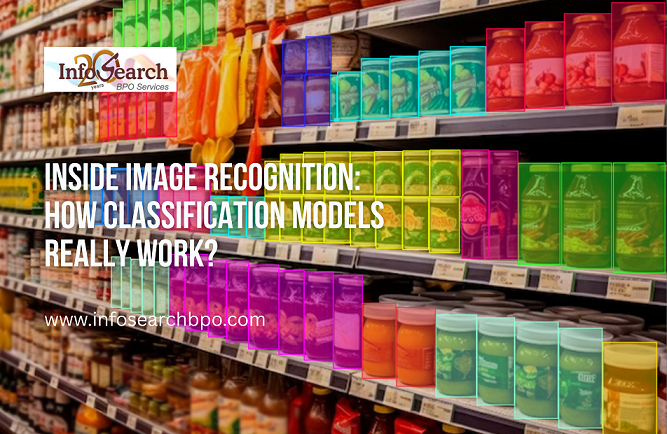
An image recognition service is an application that employs techniques of machine learning to recognize objects, persons, texts, scenes and more out of images. These services generally offer APIs, that can be utilized by various businesses to include the image recognition capability into numerous applications and services straight from the container rather than having to develop it themselves.
Infosearch provides the best custom image recognition services for AI & ML that include 3d image recognition, image object recognition, image pattern recognition, etc.
Object Detection

Optical Character Recognition

Logo and Brand Detection
Key Features of Infosearch’s AI Image Recognition Services
- Object and Scene Detection: Identify and especially separate entities (e. g., cars, people, animals) and scenes (e. g., indoors, outdoors) within an image.
- Facial Recognition and Analysis: Identify people and study features of their face; age, gender, emotional state, or individuality. Mostly, these services are applied to security and biometric applications.
- Optical Character Recognition (OCR): Text from Images which includes scanning the documents, photos of signs, letters, a document written by hand, etc.
- Custom Model Training: Certain services let you train your own image recognition models with data of your choice, this makes it possible to perform domain-level object recognition.
- Image Moderation: Detect from the images content that has violated platform policies such as containing adult content, violence and others.
- Logo and Brand Detection: Able to distinguish the logos and brand-related objects, frequently applied in marketing and monitoring of owners’ rights.
Image Recognition Annotation for AI, Machine Learning and Computer Vision
Image recognition is a key technology in AI (Artificial Intelligence), machine learning, and computer vision. It involves the ability of algorithms and systems to identify and interpret objects, scenes, and patterns within images.
We do Image recognition which is a core component of computer vision, encompassing several techniques and applications such as Object Detection and Localization, Semantic Segmentation and Image classification.
Image recognition is a crucial aspect of AI because it enables machines to understand and make sense of visual data, simulating human-like perception.
By choosing Infosearch for image recognition, businesses can benefit from scalable, accurate, and AI-powered solutions that drive efficiency and innovation across various industries.
FAQs
Image recognition services facilitate the process of image identification and interpretation of visual data by machines of images or videos. These systems use patterns of pixels to identify objects, people, scenes or actions and transform images into valuable information.
Image recognition is applied by businesses to automate visual inspection, aid in security, boost customer experiences, and aids in data-driven decision-making in many applications that include surveillance, retail analytics, healthcare imaging, and autonomous systems.
To improve recognition of images, generative AI increases the training image set, synthesizes artificially, and allows a model to acquire complex visual patterns. Generative Adversarial Networks (GANs) are some techniques that can be used to generate realistic data samples and enhance recognition accuracy, particularly in cases where real data is scarce in the real world.
Generative AI can also be used to help improve images, reduce noise, and learn more detailed features and thus create more robust and scalable recognition systems.
Yes. At Infosearch, we have image recognition solutions that enable processing of image and video streams in real time with the help of optimized algorithms and scalable infrastructure. These are the systems which analyze the visual information in real time to identify the objects, monitor the activities and create actionable information.
Online recognition is typically applied in surveillance, autonomous systems, smart retail and industrial monitoring where low-latency processing and rapid decision-making is critical.
To guarantee a high level of trustworthy and unbiased model performance, we have well-organized data preparation and quality control procedures. Our approach includes:
- Multi-dimensional and balanced training data.
- Checking of human validation and review.
- On-going model appraisal and benchmarking.
- Bias detection/mitigation practices.
- Domain data labelling guidelines.
The measures enhance the fairness, accuracy, and consistency of models in various environments and applications.
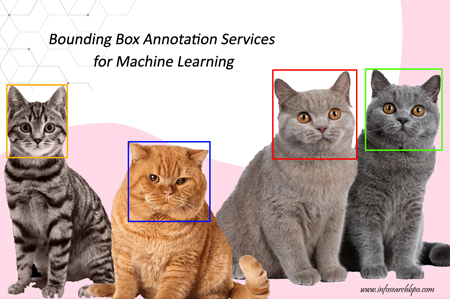
Object detection is a computer vision method that detects objects in a picture and gives the position of the object in form of bounding boxes and classifications. It goes beyond the simple image recognition that only identifies what is in an image but it also the location of this item within that image or video.
Some of the common applications of this technology include autonomous driving, inventory tracking and security monitoring.
Yes. Advanced computer vision and deep learning algorithms can be used to identify faces and people as well as analyze facial expressions to measure emotions as image recognition systems. Such features facilitate use in biometric verification, sentiment analysis of customers and surveillance.
Application will be based on the nature of the project, availability of data and the privacy laws in effect.
Image recognition allows automation of visual manual processes through the opportunity to analyze and interpret images without the involvement of a person. It facilitates automation of business by:
- Quality inspection automation and fault detection.
- Improving security and surveillance.
- Enhancement of product search and visual commerce.
- Streamlining document processing and workflow processing.
- Empowering predictive analytics and business intelligence.
Image recognition saves manpower and enhances more precise data handling, thereby making efficiency a priority and speeding up the move towards digital transformation.